
Recycling textiles in Europe is often presented as a clear sustainability win. But as the textile industry moves towards circularity, an important question emerges: Are we solving social challenges, or simply shifting them elsewhere?
While the environmental benefits of recycling are widely discussed, the social dimension often remains less visible. Social Life Cycle Assessment (S-LCA) helps address this gap by examining how production systems affect workers, communities, and society as a whole.
This question was a central topic in the presentation given by Anubhuti Bhatnagar from Aalto University at the openLCA Conference 2026 in Berlin, Germany. The openLCA Conference brings together experts from academia and industry to exchange insights on life cycle assessment and sustainability, including emerging approaches to evaluating environmental and social impacts.
To explore this question in practice, recent research presented at the conference offers valuable insights.
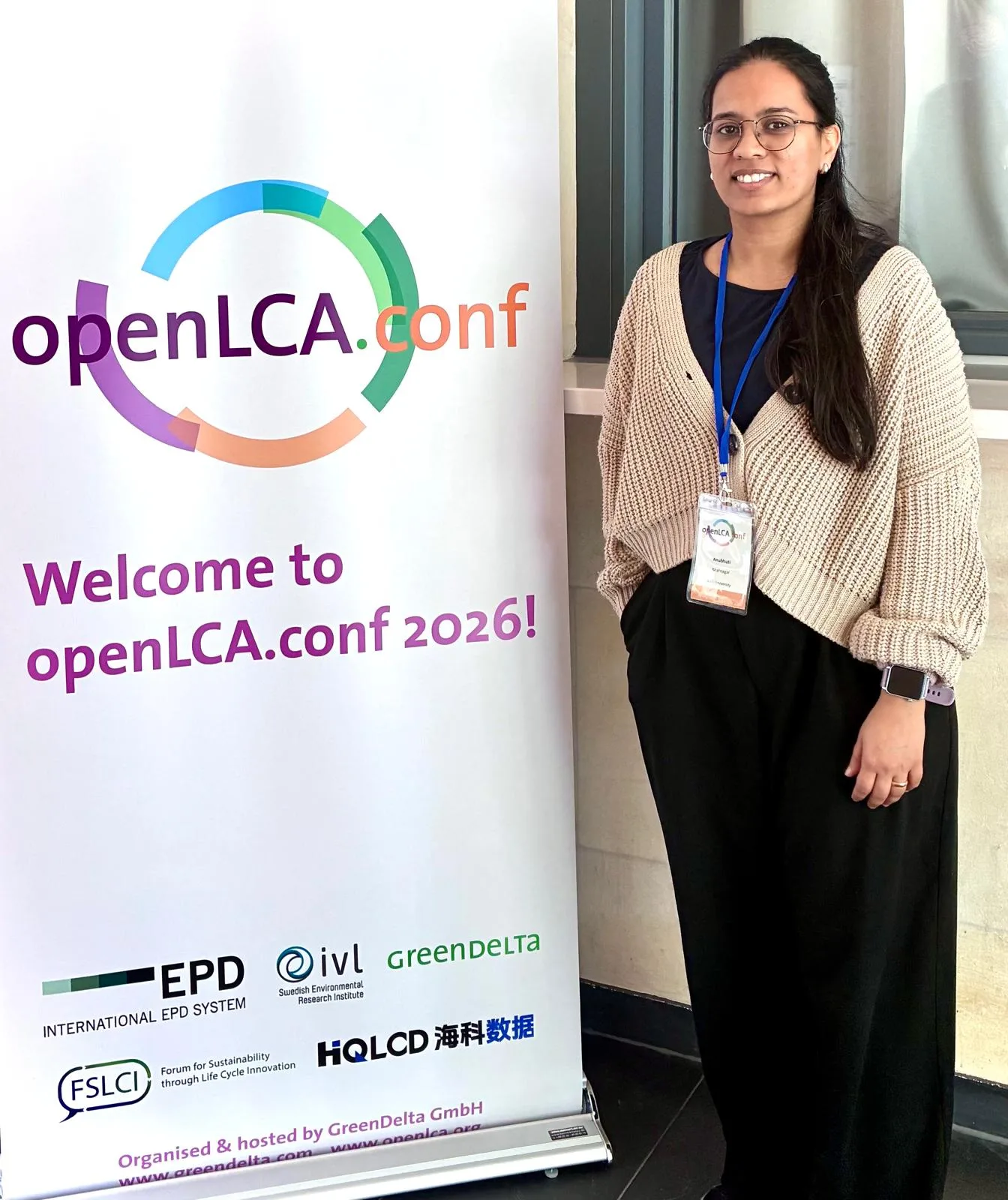
Anubhuti Bhatnagar at openLCA Conference 2026
Understanding Where Social Risks Are
At the openLCA Conference, Anubhuti explored social risks in a fibre-to-fibre textile recycling system in Europe, combining two perspectives: a) a broad risk screening using the PSILCA database, and b) a detailed site-specific assessment of seven organizations across the recycling value chain. It was shown that relying only on database-driven assessments can overlook real-world challenges. Site-specific data revealed gaps in overtime, representation, and access to benefits that are not always captured by generic models.
The findings challenge a common assumption that circular systems are inherently socially sustainable. Social risks do not disappear completely; rather, they shift across regions and stages of the value chain
At the same time, the highest risks remain upstream, particularly in cotton cultivation and garment manufacturing outside Europe. Even within Europe, gaps persist, including issues related to working conditions, governance, and supplier responsibility.
Addressing Social Sustainability in CELLFIL
Within this context, CELLFIL is developing lyocell filaments from alternative feedstocks, including textile and agricultural waste such as orange peels. But innovation in materials must go hand in hand with responsible value chains. The insights shared at openLCA directly inform CELLFIL’s approach to S-LCA.
They highlight the importance of:
- going beyond databases and collecting primary, real-world data
- addressing governance and supply chain responsibility early
- understanding how circular transitions reshape jobs, skills, and collaboration across the value chain
Why Social Sustainability Must Be Part of Circularity
Although the transition to circular textiles is essential, it is not automatically equitable. While recycling can reduce environmental impacts, it does not eliminate social risks. As highlighted at the openLCA Conference, these risks often shift across regions, actors, and stages of the value chain, requiring careful assessment and responsible management.
A process can be environmentally and economically viable yet still fall short on social sustainability. This makes it crucial to move beyond assumptions and integrate social considerations into innovation from the very beginning.
Projects like CELLFIL are contributing to this shift by embedding S-LCA into their development processes, ensuring that new materials and circular solutions are designed not only for performance and sustainability but also for fairness and responsibility across the entire value chain.